
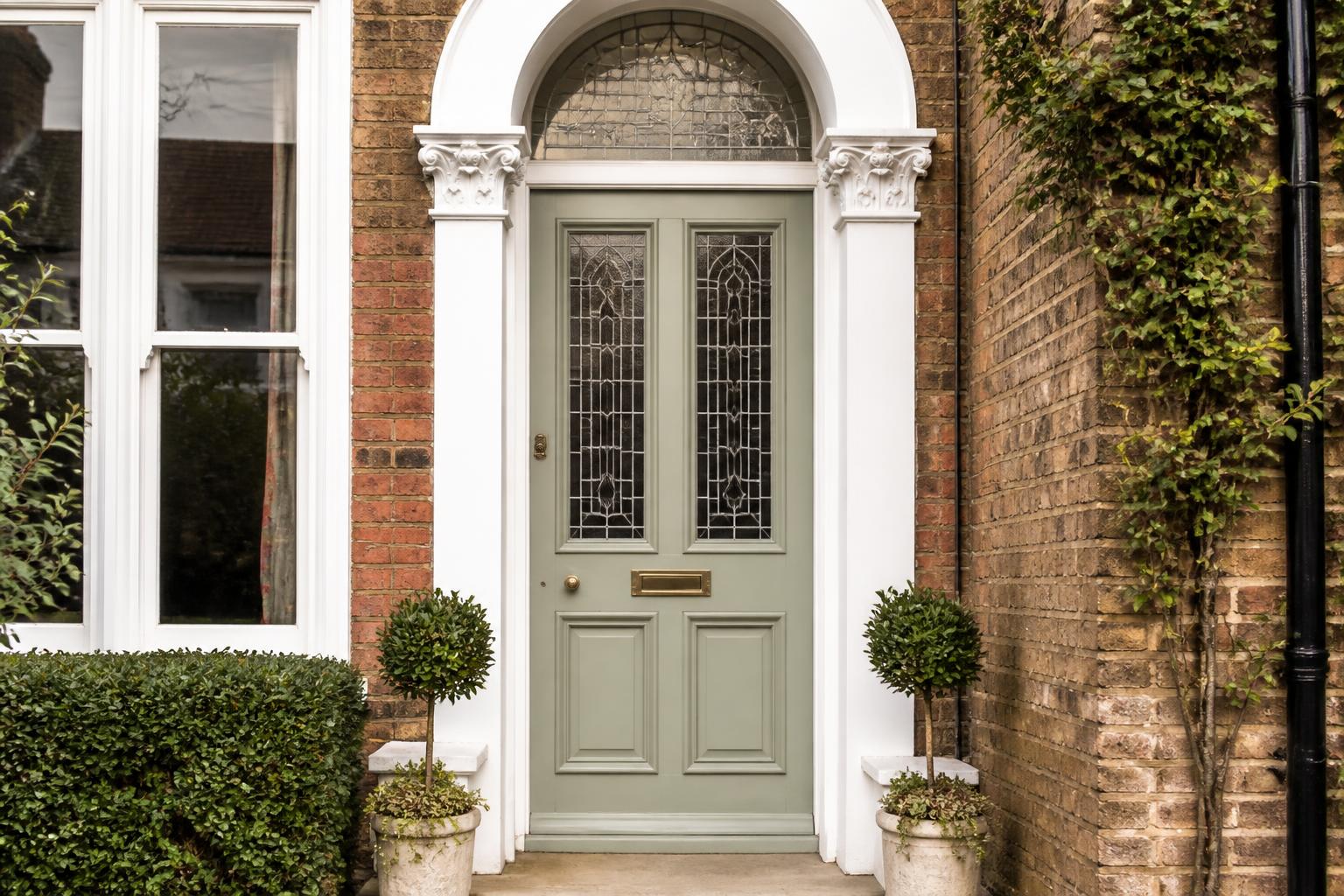
Timber Doors
Timber Entrance, French & Bi-Fold DoorsMade in Our Factory,Hung Across South West London
A door that closes cleanly on a cold February morning is a manufacturing decision, not a fitting trick, so we make yours to the surveyed opening and hang it ourselves.
Doors manufactured in-house · FENSA-certified installation
- Manufactured in our own factory
- Installed by our own teams
- Made to measure, never off the shelf
- FENSA-certified installation
The service
What this covers andwhen it is the right call
What the service covers
Entrance doors, French door sets, bi-fold sets, stable doors and side entrance doors in hardwood and engineered softwood, complete with frames, ironmongery, glazing and factory-applied finish. We survey the opening, manufacture the door and frame together as a set, and hang and adjust it with our own teams.
Who it is for
Owners of period and traditional properties across Richmond, Wimbledon, Putney and Twickenham where a plastic or composite door would look wrong on the elevation, and anyone who wants a specific panel layout, moulding, glazing or colour rather than a catalogue style.
When it is needed
When the door sticks in winter and gaps in summer, when the bottom rail or frame has softened where rain hits, when draughts run under the threshold, when the lock no longer engages without lifting the door, or when the existing door simply no longer suits the house after other work.
Why professional manufacture matters
A door is the most heavily used moving component in a house. Timber selection, joint construction, end-grain sealing, hinge specification and the accuracy of the frame together determine whether it operates for decades. Making door and frame as one set to a surveyed opening removes the on-site trimming that causes most long-term problems.
What it costs to wait
The problem does notstay the same size
A failing external door costs more than the door: it costs heat, security and the fabric around it.
Water at the threshold moves inwards
Once the cill or bottom rail is holding water, the damage reaches the floor structure and the internal finishes, turning a door replacement into a joinery and making-good job.
A door that binds is a door being forced
Every forced closure loads the hinges and the frame. The result is a dropped door, an enlarged gap and a lock that no longer aligns.
Draughts at the main entrance are constant
The entrance is often the largest single air leak in a period house, and it is felt in the hallway and every room off it.
The common mistake: a stock door planed to fit
Trimming a mass-produced door to a hand-built opening cuts through the lippings and the sealed edges, which is exactly where moisture then enters.
Our process
Five stages, one company,no handovers in between
Survey and inspection
We measure the opening, check the threshold, frame and structure around it, and record the panel layout, mouldings and glazing that suit the elevation.
Specification and drawings
Timber, door and frame sections, glazing, ironmongery, locking and finish are agreed in writing before manufacture.
Manufacture in our factory
Door and frame are machined, jointed, sealed, glazed and factory-finished as a matched set on our own production line.
Installation by our fitting teams
The set is fitted square and plumb, weathered at the threshold, and ironmongery is installed and aligned by the people who manufactured it.
Testing, adjustment and certification
Operation, closure, locking and seal compression are tested and adjusted, and qualifying replacement work is certified under FENSA.
What you get
Specific outcomes,not general assurances
Door and frame made as a set
Matched components fitted together seal properly instead of relying on adjustment to cover a mismatch.
Panel and moulding detail to suit the house
Because we machine the timber, the layout follows the elevation rather than a supplier's standard range.
Draught-sealed and weathered properly
Seals, thresholds and drainage are specified for an exposed external door, not assumed.
Ironmongery chosen for daily use
Hinges, locks and handles are sized for the door's weight and how often it is used.
Finished before it arrives
Factory coating on prepared timber outlasts a finish brushed onto an installed door.
One company accountable
Survey, manufacture, hanging and certification stay with us throughout.
In detail
Materials, methods andthe situations they suit
Entrance doors
Entrance doors are specified around four decisions: panel layout, timber and section, glazing, and locking. A four-panel Victorian door, a Georgian six-panel and a 1930s glazed door each carry different proportions, and getting the stile and rail widths right is what makes a new door look original rather than approximate.
Security is engineered rather than added: multi-point locking, reinforced keeps, quality cylinders and hinge bolts are chosen at drawing stage, along with letter plates, knockers, pull handles and numerals in a consistent finish.
French doors and bi-folds in timber
French door sets suit openings where a symmetrical pair reads correctly on the elevation and where the swing space exists internally or externally. Side panels and fanlights extend the set where the opening is wider than a pair.
Timber bi-folds fold a wide opening back against the reveal. The engineering matters more here than on any other door type: leaf weight, track specification, hinge quality and the flatness of the threshold determine whether the set still slides easily in five years.
Timber, finishes and glazing
Hardwood is specified where a stained finish shows the grain or where a slim section carries a large glazed panel. Engineered softwood is dimensionally stable and holds paint well, which suits painted entrance doors on exposed elevations.
Glazing options run from single panes and Georgian bar layouts to toughened and laminated safety glass, obscure patterns for side entrances, and acoustic units where the door faces a busy road. Safety glazing is a regulatory requirement in door leaves and adjacent low-level panels.
Thresholds, weathering and access
The threshold is where most door problems begin. Weather bars, drips, drainage and the relationship between internal floor level and external ground level are all decided at survey, and a low threshold for level access needs a specific detail rather than a shaved-down cill.
Where a door leads onto a terrace or garden that is being relaid, we coordinate the threshold level with the builder before manufacture so the finished detail works with the paving rather than against it.
Homes, conservation work and trade
Conservation and Article 4 areas across South West London frequently require timber doors of a particular pattern. Manufacturing to a specified detail is straightforward for us because there is no catalogue to work around.
For builders and developers we supply door sets to a schedule, manufactured to the site's surveyed openings and delivered to an agreed date so the programme is not held up by a door.
Straight answers
Questions we are askedabout timber doors
- What does a made-to-measure timber door cost?
- Cost follows size, timber, glazing, ironmongery and finish. We price from a survey rather than a guess, and buying direct from the manufacturer removes the reseller margin.
- How long does manufacture and installation take?
- We confirm a manufacturing and installation window in writing after survey. Production is in our own factory, so the schedule is ours to control.
- Can you copy an existing door?
- Yes. We record the panel layout, mouldings, section sizes and glazing at survey and manufacture to those details, correcting anything that has failed rather than reproducing the fault.
- How secure are timber doors?
- Security comes from the locking system, keeps, hinges and frame fixings as much as the leaf. Multi-point locking and reinforced keeps are specified as part of the door set.
- Will a new timber door stop draughts?
- A door manufactured to the opening with proper compression seals and a specified threshold detail removes the gaps that a trimmed stock door leaves behind.
- How long will the finish last before recoating?
- It depends on exposure. A south or west-facing door in full weather needs attention sooner than a sheltered one; check annually and recoat before the finish breaks rather than after.
- Do you fit the ironmongery as well?
- Yes. Locks, hinges, handles and accessories are fitted and aligned by our own team as part of the installation.
- Is a replacement door FENSA certified?
- Qualifying replacement doors are installed under FENSA certification and self-certified against the relevant Building Regulations.
- Can you match the door to new windows?
- Yes, doors and windows made in the same factory with the same finish are matched properly rather than approximately.
- Do you cover my part of South West London?
- We work across Wimbledon, Richmond, Putney, Kingston upon Thames, Wandsworth, Clapham, Battersea, Balham, Twickenham and surrounding postcodes.
Related services
Where we work
Timber Doors supplied and installed across South West London and the surrounding postcodes.
Next step
Get a timber door setmade for your opening
Send us a photograph and the basics of the opening. We will arrange a survey and confirm the specification in writing before anything is machined.
- Manufactured in our own factory, then installed by our own teams
- FENSA-certified installation on qualifying replacement work
- Office open Mon – Fri, 8am – 4pm
Tell us about your project
One short form. We will confirm the next step by phone or email.
We reply during opening hours: Mon – Fri, 8am – 4pm. Prefer to talk? Call 01483 968616.